
Most small business owners assume AI’s biggest benefit is speed, getting content or answers faster. That’s only part of the story.
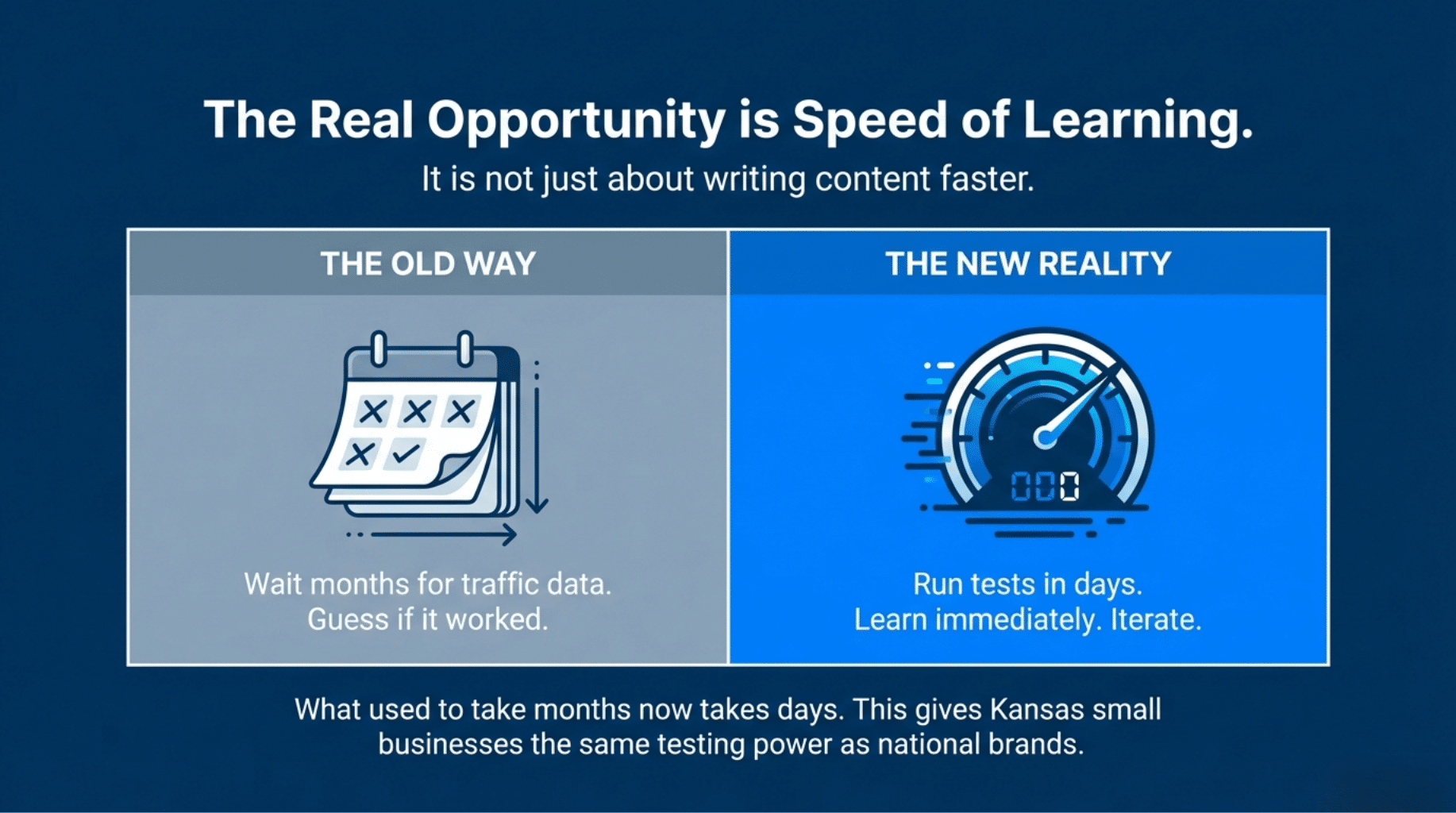
The real advantage comes from using AI to test and learn about your website faster than ever before. What used to take months of waiting for traffic data now takes weeks, or even days, giving Kansas small businesses the same testing power that big national brands have.
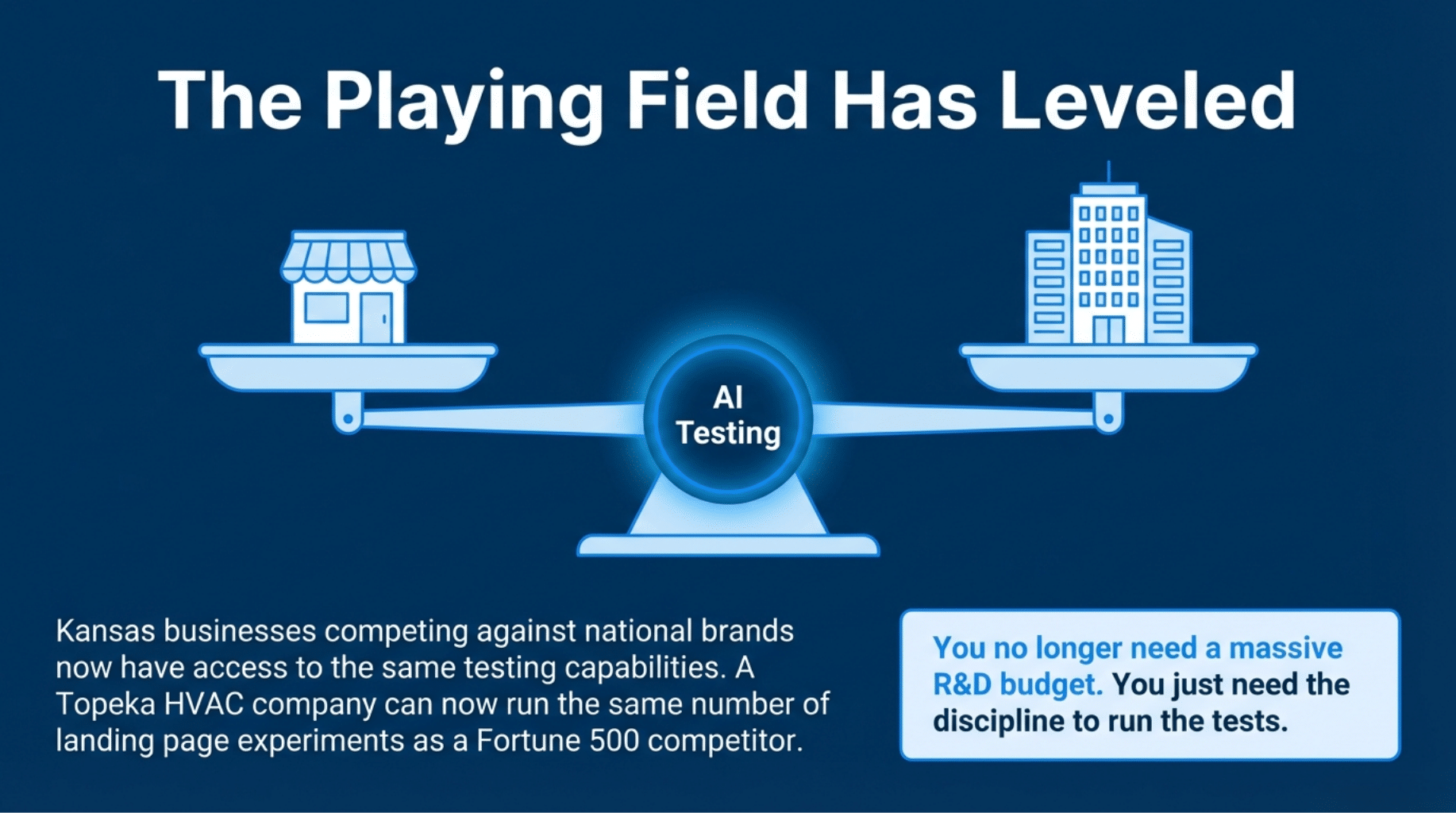
Kansas businesses competing against national brands now have access to the same testing capabilities. A Topeka HVAC company and a Fortune 500 competitor can run the same number of landing page experiments. The playing field has leveled in ways we’ve never seen.
But speed without direction creates expensive noise. Here’s how to turn faster testing into measurable growth.
From Campaigns to Operating Systems
The old model worked like this: hire someone to write website copy, launch it, wait three to six months, check your leads, decide if it worked.
The new model works differently: run continuous tests on your highest-value pages, measure results weekly, and improve constantly.
Think of your website as an operating system, not a finished product. Operating systems receive updates, respond to feedback, and get better over time.
For Kansas businesses with limited budgets, this matters enormously. You don’t need to bet everything on one version of a homepage headline. You can run multiple versions at once and let visitor behavior decide which performs best.
One KPI Per Test: Keep Measurement Simple
Here’s where many AI experiments go off track. Businesses get excited and launch multiple tests at once, tracking page views, time on site, bounce rate, form submissions, phone calls, and chat requests. Soon they face conflicting data and don’t know what actually worked.
Testing faster means nothing if you measure poorly.
Our simple rule: One primary KPI per test.
KPI stands for Key Performance Indicator—it’s the single number that shows if your test is succeeding. Everything else is secondary context.
For a landing page test, your KPI should tie directly to revenue: form submissions, phone calls, chat requests, or quote requests. For a Lawrence law firm testing two headlines, the question becomes: which headline generates more consultation requests? Other metrics like page views or time on page are secondary.
Set your stopping rules before you start:
- Minimum 100 visitors per variation before drawing conclusions.
- Statistical significance of 95% (enough data to be confident in your results).
- Maximum test duration of 30 days, no matter your traffic.
Write these rules down. Tape them to your monitor. Many small businesses abandon tests too early or run them too long without these guardrails.
Building Your Truth Layer
AI produces content fast—but it can also create mistakes, exaggerations, and off-brand messaging at the same speed.
Winning businesses document what’s true before generating anything. We call this your “truth layer.”
It includes:
- Approved claims about your products or services
- Proof points with numbers, dates, and verifiable facts
- Brand voice guidelines for consistent messaging
- Compliance requirements for your industry
- Geographic service boundaries
Every AI-generated piece of content runs through this filter. Creating the document can take time but saves hundreds of hours in corrections and reputation management.
Your competitors skipping this step will learn expensive lessons. Accuracy and consistency become competitive advantages.
What to Test First
Focus on your highest-stakes pages first:
- Contact or quote request page: Closest to revenue. Even a 20% improvement has immediate impact.
- Homepage headline & subheadline: First impressions matter.
- Primary call-to-action buttons: Text, color, placement, and size all affect clicks.
- Service or product page headlines: These pages attract people actively searching for solutions.
Skip testing your About page, blog posts, or footer content initially. Focus resources where improvements translate to leads.
Reasonable Benchmarks for Kansas Small Businesses
Conversion rates vary, but here are helpful targets:
- Landing pages: 2%–5% lead conversion. Below 2%? Start testing immediately.
- Contact forms: 10%–20% completion when visitors reach the page. Lower means friction in your form design.
- Homepage bounce rates: 40%–60% normal; above 70% may signal mismatched traffic or content.
- Mobile conversion rates: Typically 30%–50% lower than desktop. Larger gaps? Optimize your mobile experience.
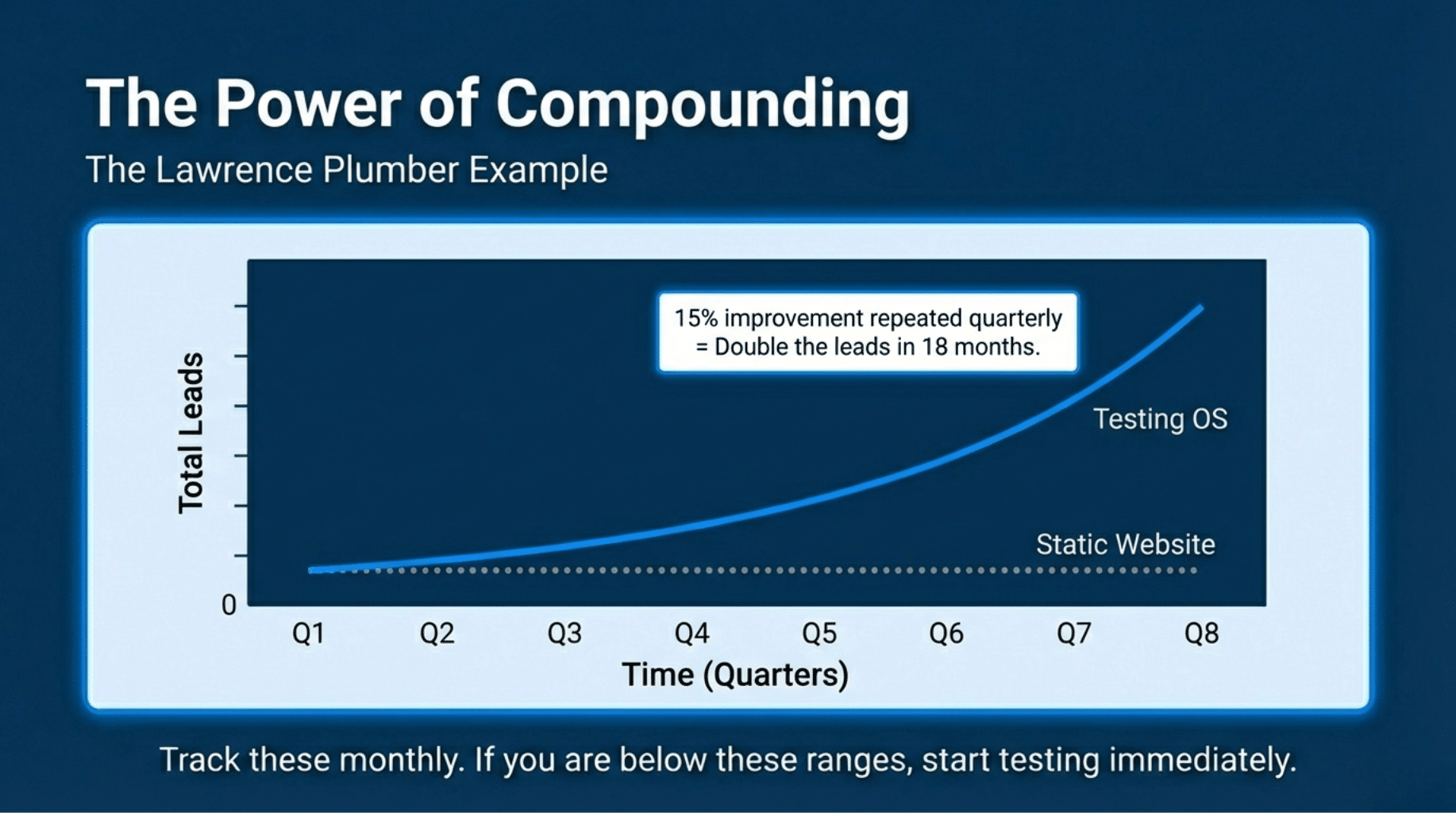
Track these numbers monthly. Small improvements compound: a Lawrence plumber improving quote request conversions by 15% gains 15% more opportunities from the same traffic. Repeat quarterly, and lead volume can double in 18 months.
Implementation Steps This Week
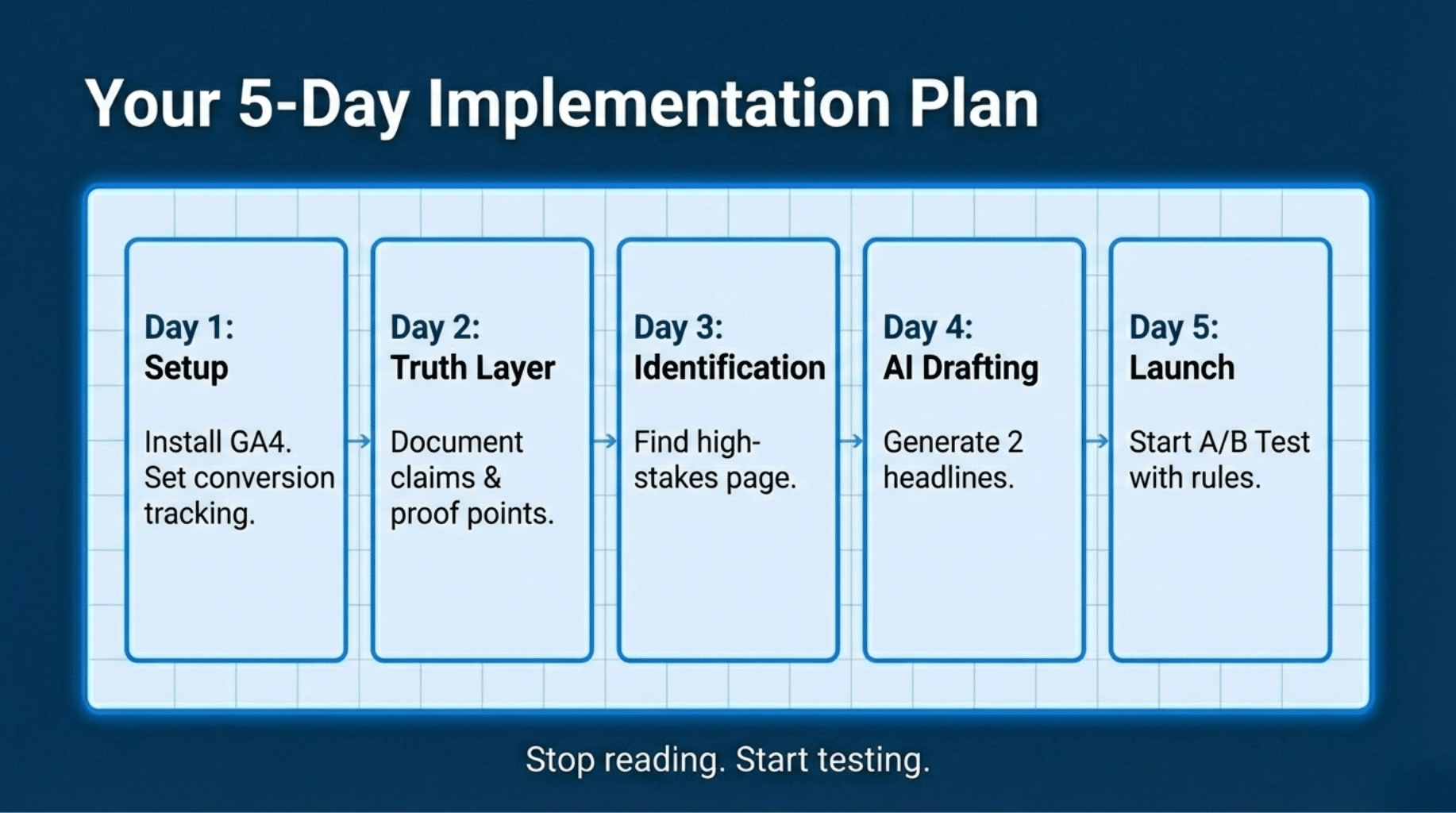
Stop reading. Start testing. Here’s your actionable plan:
Day 1: Install Google Analytics 4 and set up conversion tracking for your primary lead action.
Day 2: Document your truth layer. List all claims and verify proof.
Day 3: Identify your highest-stakes page and check its current conversion rate.
Day 4: Write two alternative headlines for that page and run them through your truth layer for accuracy.
Day 5: Set up an A/B test using your website platform or testing tool. Define your single KPI and stopping rules before launching.
Kansas businesses gaining ground share one characteristic: they test continuously instead of guessing once. AI makes this faster. Measurement discipline makes it profitable.
We help Kansas small businesses build these testing systems daily. If you want guidance specific to your website, reach out through our contact page. We’ll review your highest-stakes pages and identify your first three testing opportunities.