
I recently came across a TED Talk where a linguist argued that we are moving toward a future where learning any language other than English will become unnecessary. English dominates global commerce. English powers artificial intelligence. The trajectory is clear: the world is converging on a single language.
My first thought came in the form of a few questions like “what about Chinese?” or “what about languages with deep cultural/historical importance?”. The speaker addressed some of these thoughts in his talk but I got the main point he was trying to make about the consolidation of language. My second thought was this: English? English is a mess.
English is a hodgepodge of Germanic roots, Latin imports, French overlays, and borrowed vocabulary from dozens of other languages. Its spelling rules are inconsistent. Its grammar is riddled with exceptions. Words that sound identical mean entirely different things. If you were designing a universal language from scratch, you would never design English.
And yet here we are. Not because English is the best possible language, but because it is the language that accumulated enough momentum, enough adoption, enough infrastructure to become, in many ways, the default. The cost of switching to something more elegant, more logical, more efficient is simply too high. The world has built too much on this foundation.
This realization sparked a thought I have wrestled with for years as a business owner: the temptation to start over.
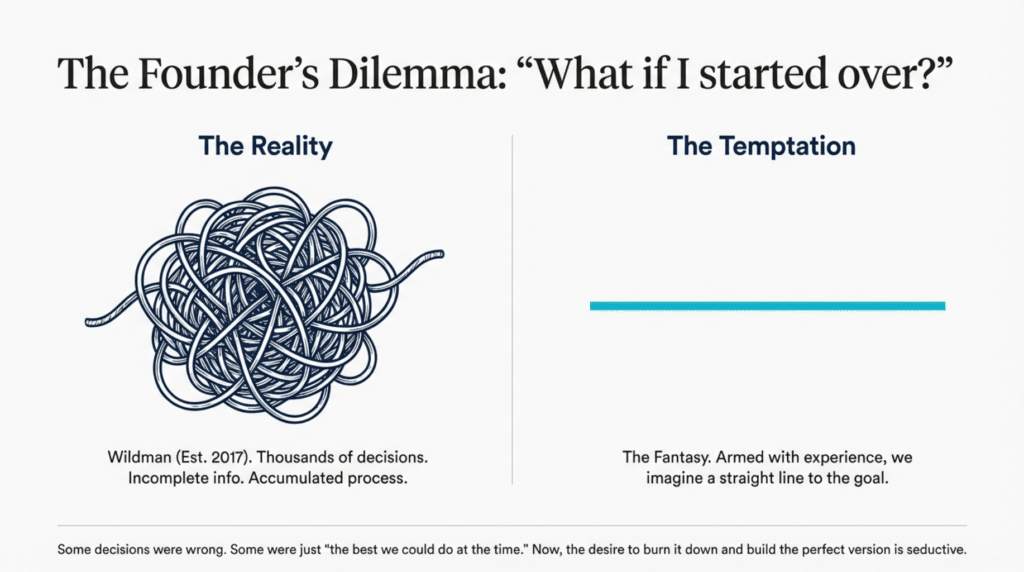
I founded Wildman in 2017. In the years since, I have built systems, processes, client relationships, and a team. I have made thousands of decisions, and a meaningful percentage of those decisions were wrong. Some were inefficient. Some were based on incomplete information. Some were simply the best I could do at the time with what I knew.
Now I know more. I have learned from failures and successes. I have seen what works and what does not. And with that knowledge comes a seductive question: What if I started over?
Imagine having a map that shows the perfect route from Point A to Point B. Not a good route. Not a fast route. The optimal route. Every turn calculated. Every obstacle avoided. Every resource deployed at the right moment.
Tear it all down. Rebuild from the ground up. Apply everything you have learned. Execute flawlessly. That is the fantasy.
The temptation has always existed for entrepreneurs. But in this era of rapid technological change, it has become almost overwhelming.
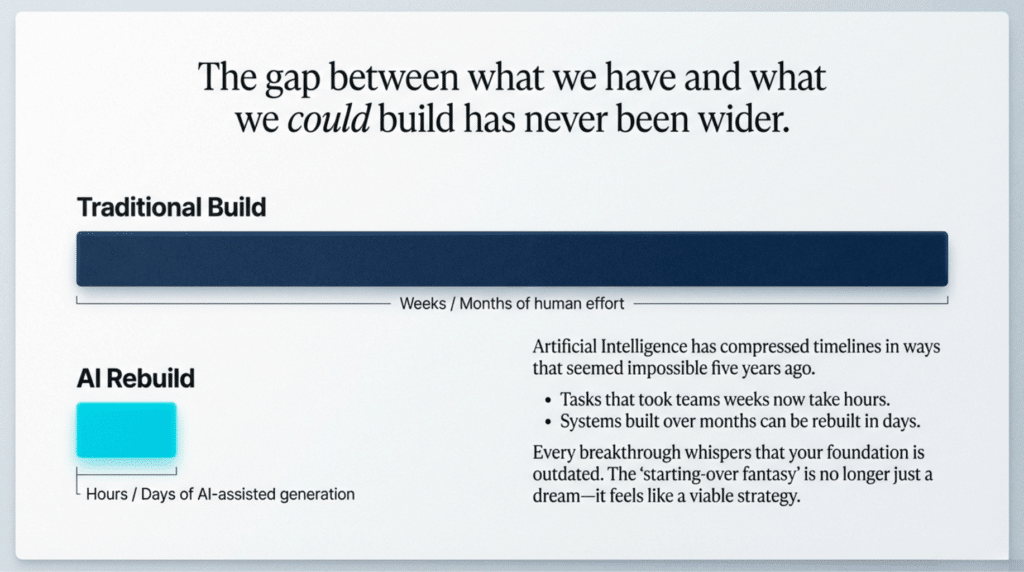
Artificial intelligence has compressed timelines in ways that seemed impossible five years ago. Tasks that took my team weeks now take hours. Systems I built over months could be rebuilt in days with the right AI tools. The gap between what I have and what I could build has never been wider.
Every new capability makes the starting-over fantasy more vivid. Every breakthrough whispers that the foundation is outdated. Every advancement suggests that the optimal path has shifted, and I am no longer on it.
This is the new reality for anyone building a business in 2026. The tools evolve so quickly that last year’s decisions feel obsolete. The temptation to reset, to begin again with current knowledge and current technology, grows stronger with every passing month.
But the temptation is a trap.
There are moments when starting over is the right choice. When a business model is fundamentally broken. When the market has shifted so dramatically that your foundation is no longer viable. When continuing forward means building on quicksand.
In those cases, the courage to abandon what you have built and begin again is essential. Sunk cost fallacy has destroyed more businesses than bad ideas ever did.
But most of the time, the temptation to start over is not wisdom. It is avoidance disguised as strategy.
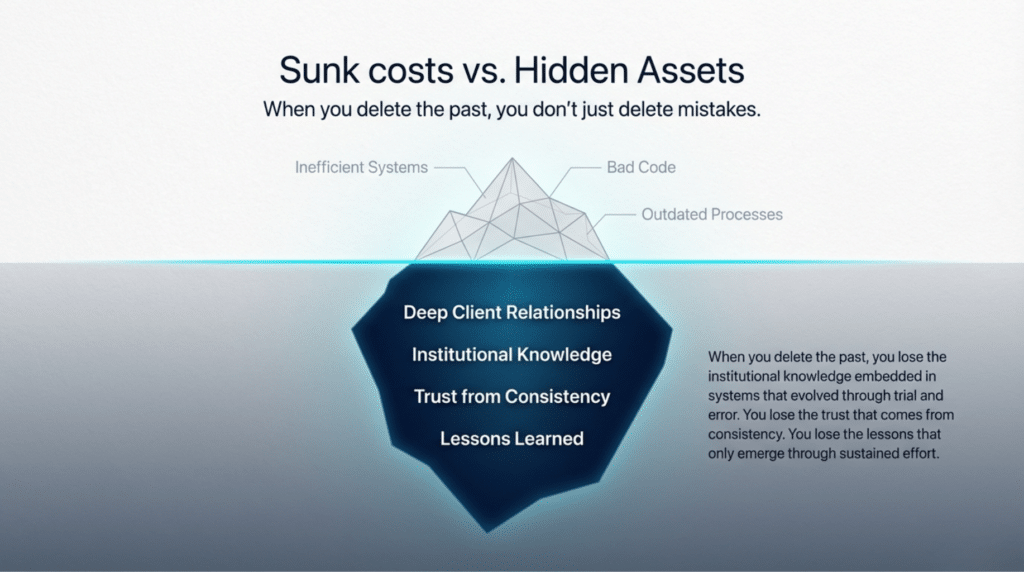
Starting over feels productive. It feels like progress. You get to imagine the clean slate, the perfect execution, the absence of accumulated mistakes. What you do not see is the cost.
You lose the relationships built over years of imperfect service. You lose the institutional knowledge embedded in systems that evolved through trial and error. You lose the trust that comes from consistency. You lose the lessons that only emerge through sustained effort.
And here is the part that is easy to forget: You will make new mistakes. Hopefully different mistakes, but mistakes nonetheless. The perfect path does not exist because the terrain keeps changing. By the time you rebuild, the map will have shifted again.
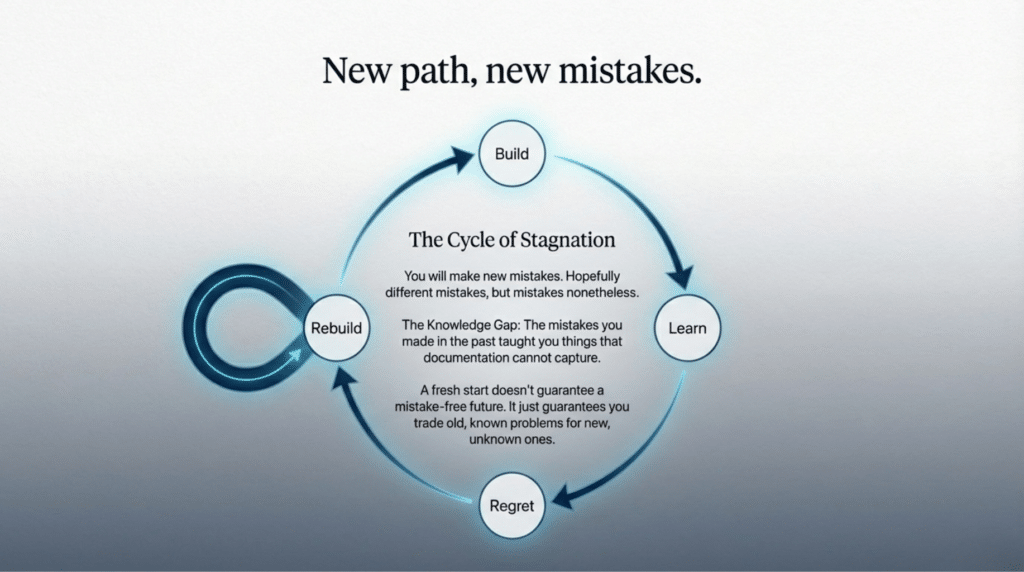
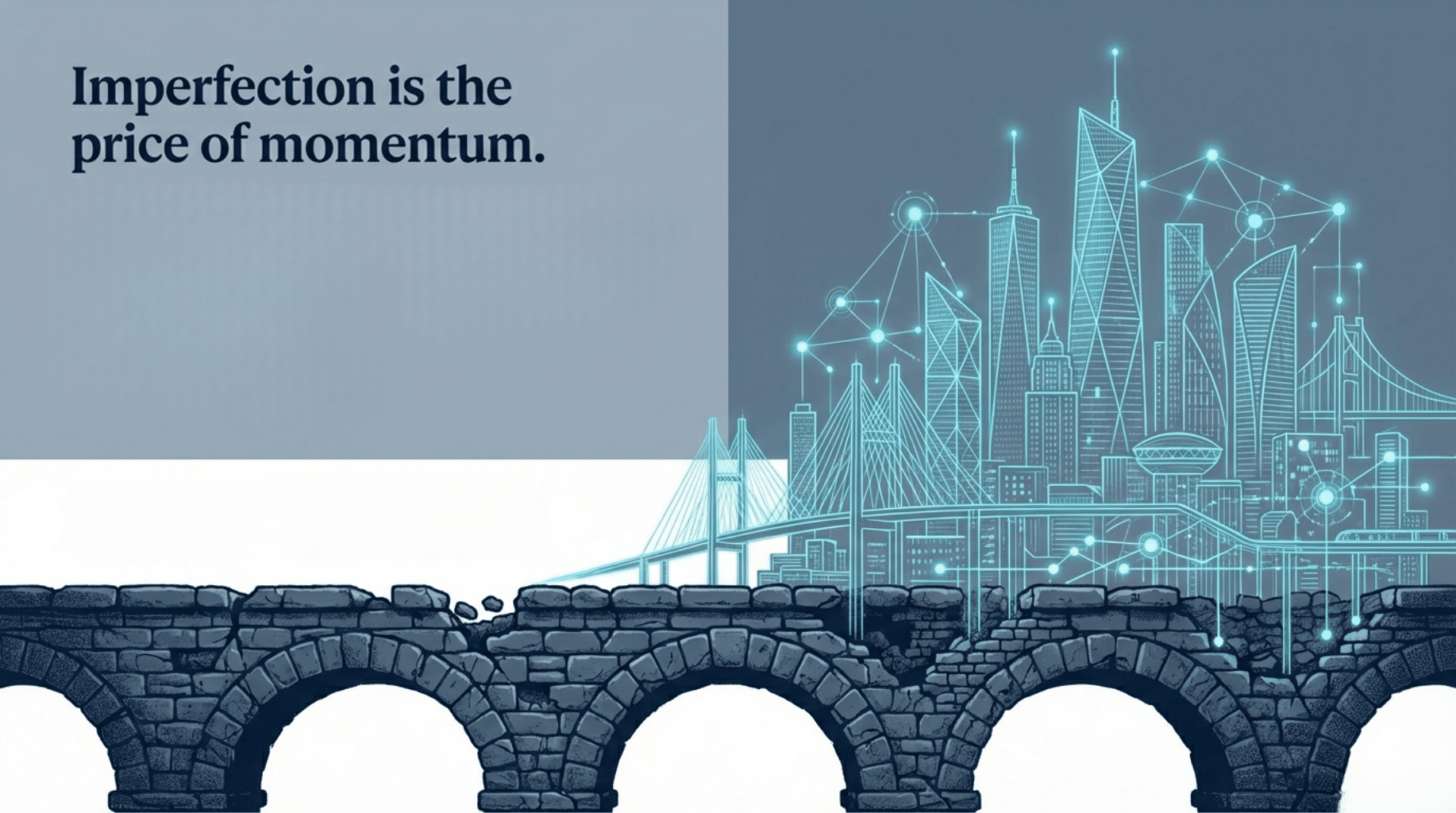
English is not winning because it is optimal. It is winning because people kept building on it. They did not stop to design something better. They took what existed and made it work for new purposes. They adapted. They evolved. They accepted imperfection as the price of momentum.
The same principle applies to business, to technology, to any creative endeavor.
The value you have built is not diminished by the knowledge that you could build it differently today. The relationships, the reputation, the learned lessons: these are assets that do not transfer to a fresh start. They exist precisely because you stayed the course through imperfection.
Yes, AI tools can rebuild systems faster. Yes, new frameworks can streamline processes. Yes, hindsight clarifies what foresight could not. But the answer is rarely to tear down and start over. The answer is usually to integrate. To iterate. To improve what exists rather than replace it.
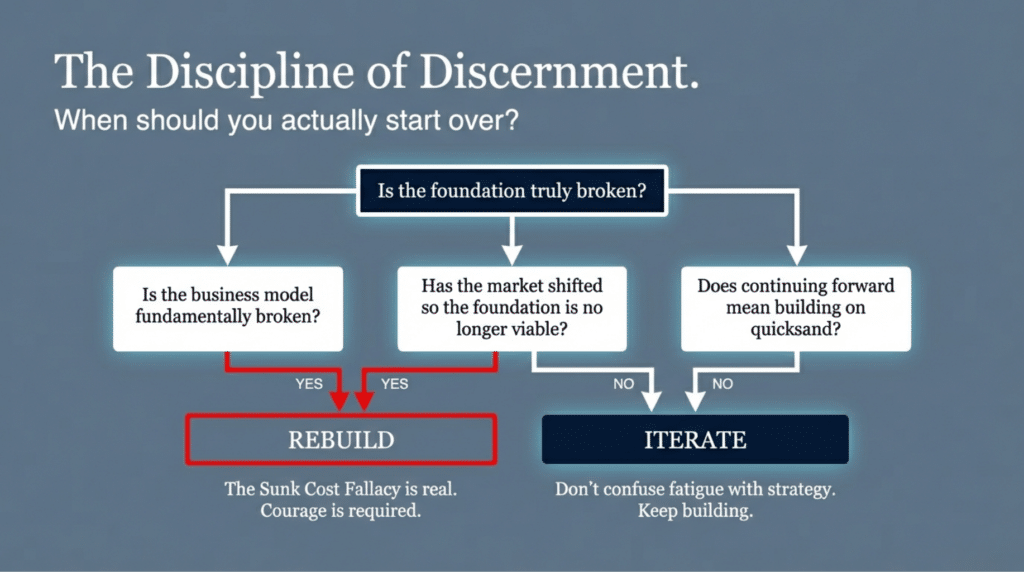
The discipline is in discernment. Knowing when to push forward despite imperfection, and knowing when the foundation is truly broken. Knowing when new technology should enhance what you have, and when it signals that what you have is no longer viable.
This is the balance I am learning. I built Wildman through years of decisions, not all of them correct. I could rebuild faster with what I know now. But faster is not the same as better. And new is not the same as right.
The messy, imperfect, evolved thing you have built carries value that a clean start cannot replicate. The mistakes you made taught you things that documentation cannot capture. The long path gave you perspective that shortcuts deny.
The world did not stop to invent a better language. It kept speaking our imperfect languages and made it work.
Keep building. Keep improving. Resist the temptation to start over every time you learn something new. The imperfect path you are on is probably closer to the destination than you think.