AI Adoption Strategy: Find Your Champions Instead of Mandating AI
 Wildman Web Solutions
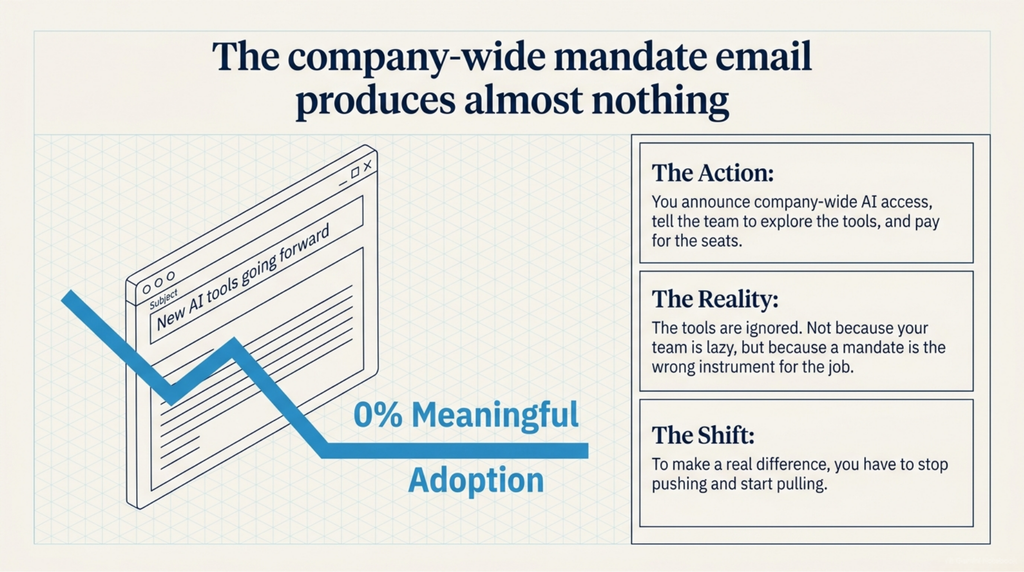
There is a specific email going out in small businesses all over the country right now. You may have already sent a version of it. The subject line is something like “AI initiative” or “New tools going forward.” The body explains that the company is investing in AI, that everyone will be getting access, and that the team should start finding ways to use it in their daily work.
That email produces almost nothing. Not because your team is lazy or the tools don’t work, but because a mandate is the wrong instrument for the job. A successful AI adoption strategy doesn’t start by telling everyone to use AI. It starts by giving the right people a reason to. If you want AI to make a real difference in your business, you have to stop pushing and start pulling.
Why AI Mandates Often Fail
Think about what your team actually hears when the AI email lands in their inbox.
The first group, and it is usually the largest, feels overwhelmed. These are people who are already busy. They have a full workload and a set of processes that work well enough. You just told them to go learn a new category of software with no clear starting point, no defined outcome, and no time carved out to do it. From their seat, you added an item to an already full plate and gave them no way to take anything off.
The second group is quieter and more consequential. These people believe, correctly or not, that AI is the technology that eventually replaces their role. Nobody says this in a meeting. Nobody puts it in writing. But it sits underneath every conversation about automation in a small company, and it changes behavior. If you believe a tool exists to make you unnecessary, you are not going to become the office expert on that tool. You are more likely to disengage, avoid experimenting, or hesitate to share what you learn.
Then there is the practical problem. Even a motivated employee facing a blank AI chat window has no idea what to type. The tools are open-ended. Open-ended is great for people who already know what they want and paralyzing for everyone else. So your motivated employee opens the tool, types something generic, gets a generic answer back, and returns to the way they were doing the work last week.
From your side, the result is the same: you paid for seats, but nothing changed.

Resistance Is a Motivation Problem, Not a Training Problem
The standard response to a failed AI adoption strategy is more training. Book a workshop. Bring in a consultant. Record a lunch and learn. Send everyone a course.
But training alone won’t change behavior if employees don’t see a reason to work differently. You’re treating a motivation gap with an information solution.
Someone can finish an AI training session knowing how to write a prompt, summarize a document, or generate a first draft and still go back to work the next morning exactly as they did before. Knowing how to use a tool and knowing when it’s worth using are two different things.
Changing an established workflow takes effort. Employees have to learn a new process, figure out where it fits into their responsibilities, and decide whether the results are better than what they already have. If the benefit isn’t clear, sticking with the familiar approach makes sense.

That’s where many AI training initiatives fall short. They teach people what the technology can do without connecting it to the work employees need to get done. A demonstration of AI writing a marketing email might be impressive, but it won’t help someone who spends three hours every Friday pulling together a report.
Training still matters. People need to use these tools effectively, recognize their limitations, and handle business information responsibly.
That starts with understanding where AI can genuinely help and where human judgment still matters. We explore that distinction in AI for Small Business Is a Tool, Not a Replacement.
But training works best when there’s a real problem to apply it to. Give someone a task they want to improve, and the skills become immediately relevant.
That’s why the first step isn’t booking another training session. It’s finding a problem worth solving.
Find Your Champions
Every business has them. Usually it’s a small group.
These are the people who already tinker. The employee who built the spreadsheet nobody asked for and now the whole department uses. The one who has strong opinions about which of your systems is bad and exactly why. The person who reorganized their own workflow twice last year without being told to.
They tend to share a few traits. They’re curious about how things work, quick to notice inefficiencies, and willing to experiment when something could be done better. They don’t necessarily have a technical background or know much about AI. What sets them apart is that they see a frustrating process and start looking for a better way to handle it.
Pay attention to the people who ask why a task has to be done a certain way, suggest improvements to existing processes, or find workarounds when your current systems fall short. Someone who regularly points out that a process is unnecessarily complicated may be just as valuable as the person already experimenting with AI. One notices the problem. The other may already be looking for a solution.
These people do not need to be sold on the idea of experimentation. Many are already trying new tools or finding shortcuts on their own. What they lack is permission. In most small businesses, spending Tuesday afternoon figuring out how to automate part of your job looks like not doing your job. Employees are expected to complete their assigned work, and experimenting with a new approach can feel like a distraction from those responsibilities.
So your champions tinker quietly, at home, in ways that never reach your operation. They might find a better way to handle a recurring task, but if that discovery stays in their personal workflow, the rest of the business never benefits. Worse, they may eventually stop experimenting because the effort isn’t recognized or supported.
Finding employees who are eager to experiment is only part of the equation. They also need a workplace that supports trying new things. Microsoft’s research highlights how much the business environment matters, finding that organizational factors such as culture and manager support have twice the reported AI impact of individual effort alone.
For small business owners, that means enthusiasm isn’t enough. If employees are expected to focus exclusively on their usual responsibilities, they may not have the time or permission to explore better ways of working. Even your most resourceful team members need your support to turn good ideas into improvements the business can actually use.
Your job is to remove that constraint. Explicitly.
Make it clear that finding better ways to work is part of the job, not a distraction from it. Let your team know that you value people who question inefficient processes and look for practical improvements. And give those people a way to bring their ideas forward without having to build a business case before they’ve had a chance to test them.
You don’t need to identify the most technically advanced person on your team or appoint an AI expert. Start with the person who is already curious about making work better. The technical skills can be learned. The willingness to look at a frustrating task and ask, “Is there a better way to do this?” is the quality you’re looking for.
Give Them One Task and the Resources to Fix It
Don’t ask your champion to “explore AI for the department.” Give them one painful, repetitive task from their own job to work on.
That distinction matters. When someone automates their own drudgery, they see the benefit directly. They’re not building a tool someone else might use someday. They’re getting their own Thursday afternoon back.
Then give them the resources to make it happen. That means paid time to work on it, a paid account for whatever tool the job requires, and your explicit backing so nobody questions why they’re working on something outside their usual task list.
The total cost of this is small. One employee, a few hours a week, one software subscription. Compare that to the cost of a failed company-wide rollout with seats for everybody and a training budget attached.
Let the Results Do the Convincing
Your champion finishes the project. The weekly report that used to take four hours now takes twenty minutes.
Now their coworkers can see the difference. The proof isn’t a vendor case study about a company they’ve never heard of. It’s a person they work with every day who has found a better way to handle a frustrating part of the job.
That’s when the questions start. How did they do it? Could it work for my job, too?
You no longer have to persuade everyone to experiment with AI. You’ve given them a real example of what’s possible, and they’re beginning to see how it could help them.
That’s the advantage of pulling people toward a solution rather than pushing them into it. The motivation comes from seeing what’s possible, not from being told to participate.
The Honest Counterargument
There is a real objection to this approach, and it deserves a straight answer.
A champion-led AI adoption strategy is slower. If you have thirty employees, this method does not touch all thirty in the first quarter. It touches one, then maybe three, then maybe eight. A mandate at least theoretically reaches everyone on day one. If you are under pressure to show your board or your partners that the whole company is on AI by a certain date, the slow approach is uncomfortable.
The trade-off is speed versus depth. A mandate can create immediate awareness and give everyone access, but access alone doesn’t guarantee meaningful use. A champion-led approach starts smaller, allowing you to test what works, demonstrate a tangible benefit, and build from there.
If you need an organization-wide AI adoption strategy, you can still set expectations and provide training. The difference is that you’re expanding a proven approach rather than asking everyone to figure it out from scratch.
There is a second objection worth naming. Concentrating this work in a few people can create a knowledge silo. If your one champion leaves, the automation they built may go with them. That risk is manageable. Ask your champion to document what they built as part of the project. A simple written record of the workflow, the prompts, and the tools used. Make documentation part of the assignment from the beginning rather than something you chase afterward.
How to Start Your AI Adoption Strategy Today
You don’t need a strategy document or a budget cycle to get started. Sit down with one tech-curious person on your team and ask:
What is the single most boring, repetitive task you do every week?
Let them answer fully. The first answer is often not the real one, so ask what else. You are looking for the task they describe with visible irritation.
Then open Claude or ChatGPT or whatever AI assistant you have access to. Paste in a sample of that task. Real examples work better than descriptions, so use the actual report, the actual email thread, the actual data. Before sharing real examples, remove sensitive customer, employee, or business information unless you’re using a tool approved for that data.
Then use this prompt.
“Act as an efficiency expert. Create a step-by-step prompt or workflow to automate or speed up this specific task.”
The goal isn’t to get a perfect workflow on the first try. It’s to give someone the permission and resources to solve a real problem, then see what you can learn from the result.
One person. One task. Then let the rest of your team come to you.