SEO Is Not Dead. It Changed: The Rise of Answer Engine Optimization
 Wildman Web Solutions
Every few years someone announces the death of search engine optimization. And every year they’re wrong, at exactly the moment the profession is doing its most interesting work.
We’re in one of those moments right now. AI search arrived, the mechanics shifted underneath everybody, and the internet filled up with posts declaring the whole discipline finished. Answer engine optimization is one of the names being used for the new approach to search, but the name matters less than understanding what actually changed.
It’s worth putting this in context, because if you’ve paid attention to the world of search long enough, this is just another time the ground moved. The space has survived every shift and it will survive this one, but only for the people who bother to learn what actually changed.
The Full Sentence Era
Go back to the early consumer internet. Ask Jeeves is the clearest example of how people searched back then.
Someone opened a browser with a problem and typed the problem out. Not keywords. An actual sentence, often several, with punctuation and detail.
“Dear Jeeves, how do I repair a kitchen faucet that leaks from the base whenever the water is turned on?”
People wrote to the search engine the way they would write to a knowledgeable person, because that is what the interface invited. Ask Jeeves was built around natural language questions and the name told you so.
Optimization in that era followed the behavior. If people searched in complete sentences, your pages needed to contain complete sentences that matched. Long form prose. Question and answer phrasing. Content that read like a person explaining something to another person, because the query looked like one person asking another.
That was the game. Everyone who worked in search learned it.
The Keyword Era
Then users adapted, which is the part people forget. Search behavior doesn’t change because engines change. It changes because people change their habits.
Users noticed that the full sentence was unnecessary. The engine didn’t need “Dear Jeeves” or the polite framing or the complete grammatical structure. It only needed meaningful words. So people started stripping their questions down.
“fix leaking kitchen faucet base”
A disjointed pile of words instead of a full sentence. Faster to type and, at the time, better results.
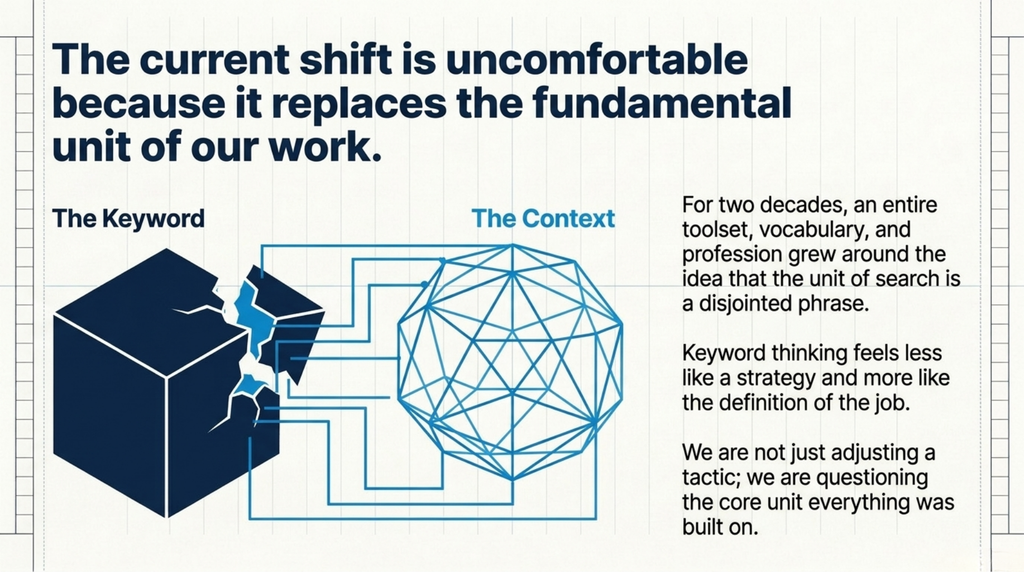
The space followed. SEO reorganized itself around keywords. Keyword research, keyword density, search volume, competition scores, long tail variants. An entire toolset and vocabulary grew up around the idea that the unit of search is a phrase somebody types.
That is where the industry has lived for a long time. Long enough that many practitioners have never worked any other way, and long enough that keyword thinking feels less like a strategy and more like the definition of the job.
That is exactly why the current shift is uncomfortable. It’s not adjusting a tactic. It’s questioning the unit everything was built on.
The AI Search Era
Now search is changing again, and this shift is larger than the move from sentences to keywords.
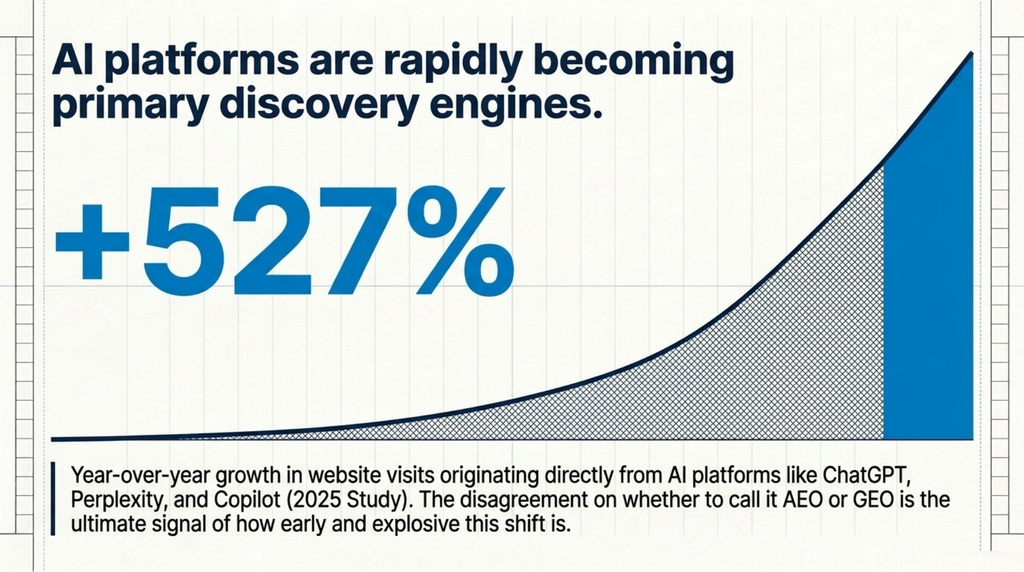
You will hear it called AEO, for answer engine optimization. You will also hear GEO, for generative engine optimization or generative optimization. The SEO space has not settled on a name yet. That disagreement is a useful signal about how early we are. Nobody names a mature discipline three different things.
Here is the mechanical change that answer engine optimization is responding to, and it matters more than the acronym.
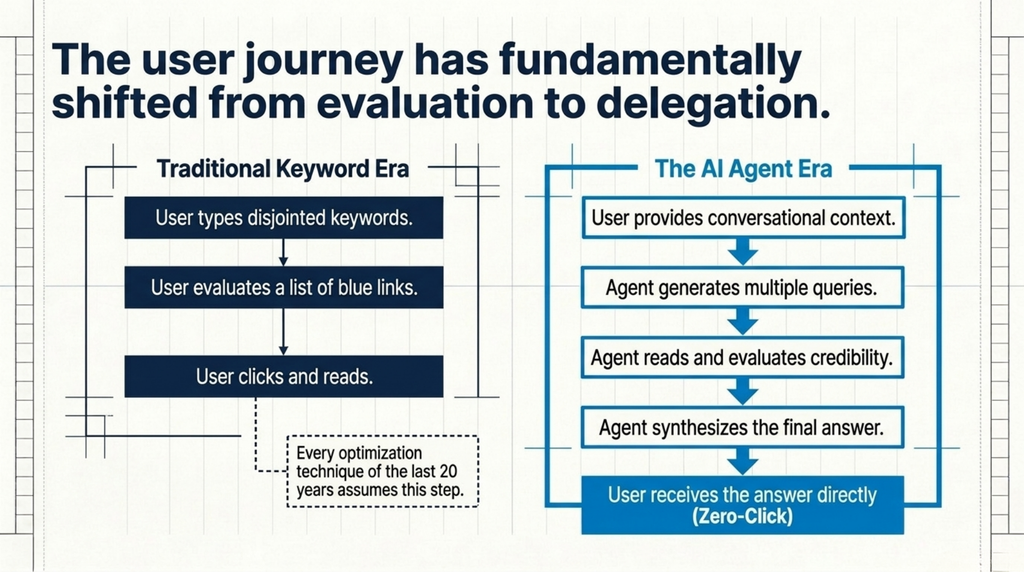
In both previous eras, a human did the searching. They typed something, looked at a results page, evaluated the options, and clicked. Every optimization technique of the last twenty years assumes a person reading a list of links.
That assumption is breaking. AI is increasingly becoming part of how people find information online. One 2025 study found that visits to websites from AI platforms like ChatGPT, Perplexity, and Copilot grew 527% compared with the previous year. That growth shows AI platforms are becoming a more measurable part of how people discover businesses and information.
But the bigger change isn’t just where people find information. It’s how they ask for it.
Instead of typing a few keywords into a search box, people can give an AI agent the full context of what they need. They describe the situation, sometimes at length, often conversationally, and frequently include details they never would have typed into a traditional search.
Then the agent goes and does the searching, which is where answer engine optimization becomes fundamentally different from traditional SEO. It generates its own queries, possibly many of them. It reads the pages that come back. It evaluates which sources seem credible and which actually address the question. It synthesizes an answer from what it found. And it hands that answer to the person.
The person may never see a results page. They may never see your homepage. They may never know which sites contributed to the answer they received.
Your target is no longer a ranking position. Your target is inclusion in the set of sources an agent uses when it constructs an answer.

What That Actually Requires
That is the practical challenge answer engine optimization is trying to address: making your website useful to the systems that are searching, evaluating, and selecting information.
That gives us three things to pay attention to.
How AI searches. An AI agent can take a detailed question and break it into several searches to find the information it needs. Someone might ask, “What are the best accounting firms for a small construction company in Kansas?” The agent could then search for local firms, compare their services, look at reviews or other sources, and narrow down the options. Your website needs to clearly explain what you do, who you serve, and the questions you can answer so it has useful information to work with.
How AI decides what to trust. An AI has to sort through the information it finds and determine which sources are useful. That makes clear, specific, trustworthy content more important. Explain who you are, what you know, what you offer, and where your information comes from. Don’t make the reader, or the AI, dig through vague marketing language to figure it out.
How AI finds the answer. If your page eventually answers a question but takes eight paragraphs to get there, an AI may have a harder time identifying the useful information. The answer should be clear and easy to find. If you answer a common customer question, actually answer it. If you make a claim, explain it. If you offer a service, say exactly what it includes.
And then there is the question itself. This may be the biggest shift of all for answer engine optimization. The search an AI runs depends on the problem the person described to it. That means the goal isn’t just to predict the exact phrase someone might type into Google. It’s to understand what your customers are actually trying to accomplish and make sure your website addresses those needs.
Search history rhymes more than it repeats.
Why “SEO Is Dead” Is Wrong
The declaration comes from a real observation. Traditional search traffic is under pressure. When an agent answers the question directly, the click that used to land on your site sometimes doesn’t happen. Zero-click behavior is a genuine problem for anyone whose model depends on volume of visits.
But that describes a channel changing shape, not a marketing tactic ending. Answer engine optimization is an evolution of that work, not a replacement for it.
The underlying job of SEO has never been “rank on Google.” It’s always been to make sure that when someone out there has a problem you solve, your business is what they find. The mechanism has changed repeatedly. In the Jeeves era it was matching full sentences. In the keyword era it was matching phrases. In the agent era it’s being selected by a system that reads and evaluates before it recommends.
Same job. Different mechanism.
The people declaring SEO dead are, in most cases, describing the death of a specific tactic set they had gotten comfortable with. Keyword density does not carry the weight it used to. That’s not the end of search optimization any more than the arrival of keywords was the end of it in 2003.
The Counterargument, Taken Seriously
There is a stronger version of the pessimistic case, and it deserves a straight answer rather than a dismissal.
The strong version goes like this. In previous shifts, people still chose from a list. Even in the keyword era you could earn visibility by being the best result, and the user made the final call. In the agent era, a model makes the selection, and that selection process is opaque, changes without notice, and is controlled by a handful of companies. You cannot audit it. You cannot appeal it. You’re optimizing for a black box that may be rewritten next quarter.
That concern is fair. It’s also not new. Google’s ranking algorithm has been an opaque black box controlled by one company for twenty years, updated without warning, and capable of removing a business’s traffic overnight. Practitioners learned to work with it by observing behavior, testing, and building the kind of quality that survives algorithm changes because the algorithm is trying to detect it.

The same approach applies to answer engine optimization. You cannot read the weights. You can observe what gets cited, test what gets picked up, and build pages that are clear, specific, well sourced, and genuinely answer the question. Those properties are what the systems are attempting to identify. Building them is the closest thing to a durable strategy that has ever existed in this field.
The honest caveat is that this is early. Anyone selling you a settled AEO methodology in 2026 is selling you a guess with confidence attached. The practitioners worth listening to right now are the ones testing and reporting what they see, not the ones with a finished framework.
The Name of the Game Now
Search has changed multiple times. Full sentences to keywords to agents. Search engine optimization to answer engine optimization. Each shift made a set of tactics obsolete and rewarded whoever learned the new mechanics first.
Here is what answer engine optimization looks like today.
Learn how AI agents talk. Learn how they search. Then optimize your site to be the answer for the question an AI agent has not asked yet.
That last part is the whole thing. With answer engine optimization, you’re not chasing a query that already exists in a keyword tool with a volume number next to it. You’re anticipating the problem a person will describe to an agent tomorrow, and making sure that when the agent goes looking, what it finds on your site is clear enough, specific enough, and credible enough to become part of the answer.
That is a harder job than keyword research. It’s also a more interesting one, and it’s the one that is available right now.