Show up when local customers search.
SEO AI pushes your business details to 300+ sites in one click and keeps every listing accurate — so you climb local search and get found on maps, Siri, and AI assistants.

What SEO AI does
Update your name, address, hours, and details once — they sync everywhere in one click.
Wrong hours and old numbers cost you customers. Keep every listing accurate and identical.
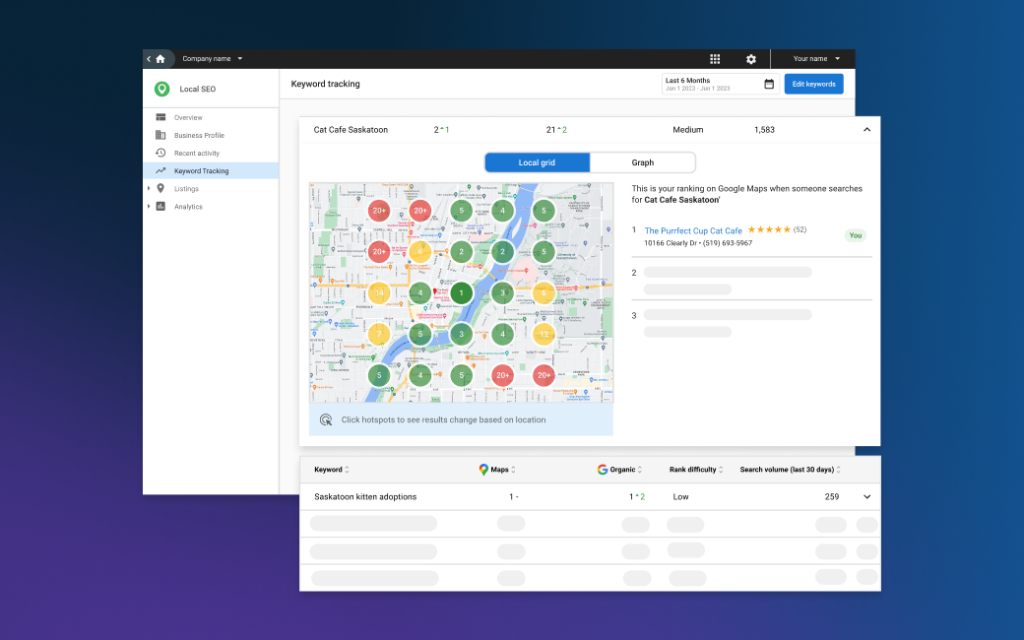
See how you rank in local search over time and know exactly where to improve.
Get found by customers nearby.
- One-click listing sync to 300+ directories
- Name, address, and hours consistent across the web
- Google Business Profile management and local rank tracking
- Visibility across maps, voice search, and AI assistants
What is local SEO software?
Local SEO software manages the business information that search engines and directories hold about you, and shows you where you actually rank when somebody nearby searches. It handles two jobs that decide whether you appear in the map results at all: keeping your details identical everywhere, and telling you the truth about your position.
SEO AI does both from one place. You update your name, address, phone number, hours, categories and description once, and it pushes that record out to the directories that matter. Then it tracks your ranking for the terms you care about, on a map, so you can see the areas where you show up and the areas where you do not.
This is deliberately not the same thing as content or link building. It is the plumbing underneath local search, and it is the part most businesses have never checked.
Why does listing consistency matter so much?
Because a search engine that finds three different phone numbers for you becomes less certain you are one real business, and certainty is what it ranks on. Inconsistent details are the most common local ranking problem we find, and almost nobody knows they have it.
The details drift on their own. You move, change a number, adopt a new suite number, shorten your trading name — and the old version stays on directories you have never logged into, some of which you did not create. Aggregators then copy the old record onward, which is how a phone number you stopped using four years ago is still being served to customers.
There is a direct revenue cost as well as a ranking one. Wrong hours send somebody to a closed door, and a dead phone number sends them to a competitor with a live one. We have written at length about why name, address and phone consistency carries so much weight, and about how data aggregators quietly copy your details onward.
Where does SEO AI publish my business details?
To the core platforms directly, and to a much wider network through data aggregators. The direct list covers Google, Facebook, Apple — through a secure connection to Apple Business Connect — plus Bing, Instagram and X.
Beyond those, submitting your details to the major aggregators propagates your record to 300+ platforms, which is how you end up correctly listed on sites you would never think to visit. An expanded sync option adds direct control of individual sites including Yelp, Better Business Bureau, Foursquare, MapQuest, Yahoo, Uber, Nextdoor, Alexa, Manta, Superpages, DexKnows, Citysearch, Hotfrog and Cylex.
The practical value is not the size of the number. It is that voice assistants, in-car navigation, and AI answers all read from this layer, and each of them is a place a customer can now find you or fail to.
How do you know where you actually rank?
On a grid, not a single number. SEO AI checks your position from many points across a map rather than from one location, so you see your ranking as a picture: strong in some blocks, invisible three streets away.
This matters because there is no such thing as your ranking in local search. Position depends on where the person searching is standing. A single-number rank report is an average that hides the thing you most need to know, which is the shape of your coverage and where it stops.
You can set the grid to cover a tight radius or a wide one depending on how far your customers travel, and you track a set number of keywords with the option to add more. Every keyword records where it stood when you started, so progress is measured against a real baseline rather than a memory.
Can AI pick the keywords for me?
It suggests them, and you decide. SEO AI proposes terms to track based on your business, location and services, which is genuinely useful when you have no idea what your customers type. It also drafts business profile content — descriptions and service listings — from your name, location and services.
The AI is good at generating candidates and poor at knowing which ones are worth money to you. A term with modest volume from people ready to buy beats a popular one asked by people doing research, and only you know which of your services actually pays.
Our recommendation: let the AI produce a long list, then cut it to the terms where a customer arriving on that search would be a customer worth having. If you would rather we did that selection and the ongoing work, that is a service rather than a piece of software.
What does the Google Business Profile side do?
It pulls your Google Business Profile insights into the same dashboard as everything else, so the actions customers took — calls placed, direction requests, map views — sit next to your rankings rather than in a separate app you never open.
That pairing is what makes the data usable. Rankings on their own tell you about visibility; profile insights tell you about behavior. Seeing them together is how you learn that a ranking improvement in one part of your map produced actual phone calls, and another one produced nothing.
Your Google Business Profile is usually the single highest-return asset in local search, and for most businesses it is also the least maintained.
Who is SEO AI for?
Businesses that serve customers in a physical area and rely on being found nearby. Trades, clinics, restaurants, retailers, professional services, anybody with a van or a front door. If a meaningful share of your customers find you by searching with intent to buy locally, this is the layer underneath that.
It is especially worth it if you have moved, rebranded, changed phone systems, or acquired another business — all four scatter inconsistent records across the web, and cleaning that up by hand is a genuinely miserable week of work.
It is not the right tool if you sell nationally online and have no service area, because none of the local signals apply to you. In that case your search work is content and technical, not listings.
What does SEO AI cost?
It is a subscription, with the level depending on how much of the network you want direct control over and how many keywords you track. The base covers listing management across the core platforms plus profile insights. Expanded listing sync and the map-grid rank tracking sit above that, and keyword tracking extends in blocks if you need more terms.
We quote after looking at what state your listings are actually in, because that is the variable that matters. A business with one clean Google profile and a business with eleven conflicting records across four aggregators need very different amounts of work in the first month, even though the software is the same.
Ask us for the audit either way. Finding out which directories are holding wrong information about you is worth having whether or not you buy anything.
How do we start?
With an audit. We check what every major directory currently says about you, flag the records that disagree, and show you the map grid for a handful of terms you care about so you can see your current coverage before anything changes.
SEO AI is one of five products in the Business Platform, and it is strongest next to Reputation AI, because listings and reviews are the two largest inputs into local ranking and improving one while ignoring the other wastes half the effort. If you want the strategy and the ongoing work done for you rather than the software to do it yourself, that is our SEO service. Either way, book a call.
Is this software, or is it SEO?
Software. That distinction is worth being clear about, because a lot of the industry blurs it and the difference determines what you are actually buying.
SEO AI fixes and maintains the local layer: your listings, your profile, your visibility on the map, tracked over time. It does not write your website's content, earn you links, or fix technical problems on your site — and no listings tool does, whatever the marketing says. For a business whose local presence has never been cleaned up, this layer alone often produces the fastest movement available, which is why we start here. The table below sets out what sits inside the software and what does not.
| Part of local search | Covered by SEO AI | Where it belongs instead |
|---|---|---|
| Business details on Google, Apple, Bing, Facebook | Yes, updated once and pushed out | — |
| Listings on 300+ directories and aggregators | Yes, through data distribution | — |
| Fixing records that already disagree with each other | Yes, found in the audit and corrected | — |
| Google Business Profile insights and monitoring | Yes, in the same dashboard as rankings | — |
| Map-grid rank tracking on your keywords | Yes, from many points rather than one | — |
| AI suggestions for keywords and profile content | Yes, as candidates for you to approve | — |
| Choosing which keywords are commercially worth it | Partly, the AI proposes and you decide | A person who knows your margins |
| Writing and improving your website content | No | Our SEO service, or your own writing |
| Technical fixes on your website | No | Our SEO service, or your developer |
| Earning links from other websites | No | Our SEO service and your own relationships |
| Getting more reviews and replying to them | No | Reputation AI, which pairs with this |
Local listings and rank tracking: common questions
How many keywords can I track, and can I add more?
The standard allowance is fifteen tracked keywords, and it extends in blocks of fifteen if you need more — so thirty, forty-five and upward. Most single-location businesses are well served by the first fifteen.
Resist the urge to fill every slot. Fifteen terms you check and act on beats sixty you skim once a quarter, and the temptation to track vanity terms you will never rank for wastes slots that a buying keyword could have used.
How wide an area does the map grid cover?
It defaults to a radius of just over a mile and can be widened to two and a half, five, or ten miles. Ten suits a larger city or a business whose customers travel; the tighter settings show more useful detail for a neighborhood trade.
Pick the radius that matches how far someone would realistically drive to you. A grid far wider than your actual catchment mostly produces discouraging red squares in places that were never going to call.
What does the "started at" figure mean on a keyword?
It is the position that keyword held when tracking began, so every later reading has something to be compared against. It is the baseline that makes progress legible.
One thing to watch: the figure shifts with the date range you have selected, showing the position at the start of that window rather than the day you first added the term. If a number looks wrong, check the date picker before concluding anything moved.
Will my listings be wrong while the changes propagate?
There is a lag rather than an error. Direct platforms like Google and Facebook update quickly; records travelling through data aggregators take longer to appear everywhere, sometimes several weeks, because each downstream site refreshes on its own schedule.
The audit at the start tells you which records are currently wrong, so you know what is being corrected and roughly when to expect each one to settle.
Do I still need a website if my listings are accurate?
Yes. Listings decide whether you appear in the map results; your website is where somebody decides whether to actually call you. They do different jobs, and a strong profile pointing at a weak site converts badly.
The two also reinforce each other. Search engines cross-check the details on your site against the details in your listings, so a site with clear, consistent contact information makes the whole local picture more credible.
Ready to put SEO AI to work?